
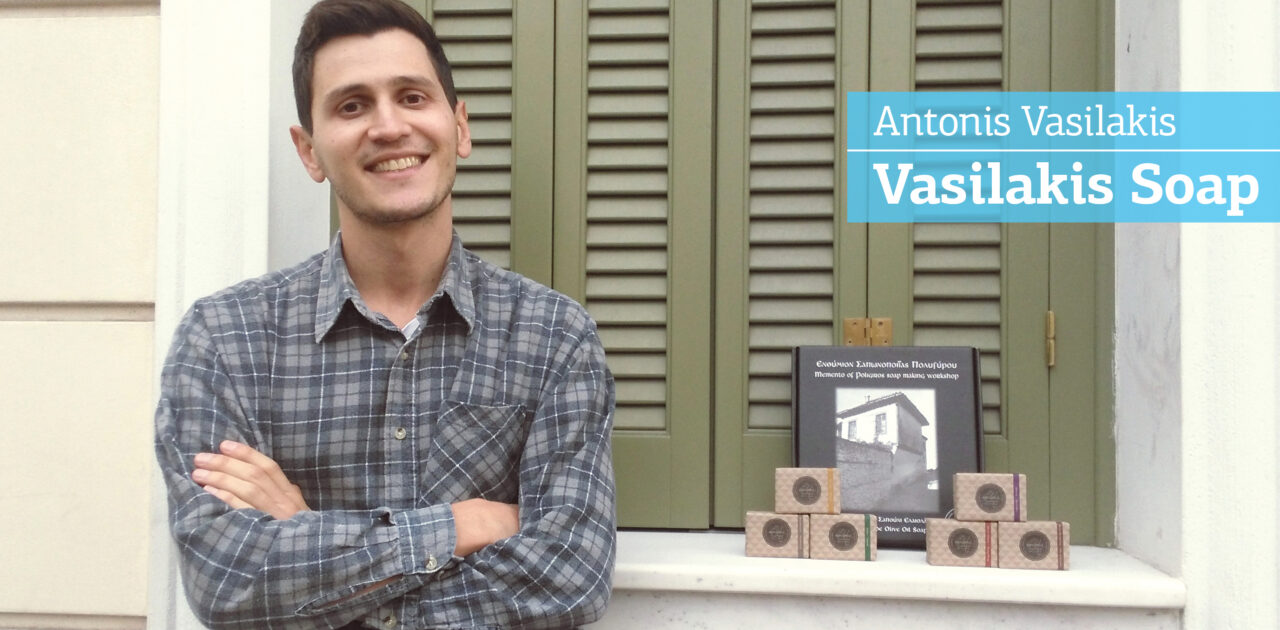
How does a young person decide to engage in something as traditional as soap-making? Let’s get to know Antonis Vasilakis in 10 questions, as he takes us on a journey through scents and images of another era…
Tell us a bit about yourself. How did you get started? What inspired you to work with soap?
I grew up in my father’s hometown, Polygyros in Halkidiki. In 2006, I graduated from the Department of Physical Education and Sports Science at Aristotle University of Thessaloniki, specializing in Special Education and Posture Correction. My career path changed after 2011, as I turned to more alternative choices. I was always fascinated by nature and the earth… My father, who has long been involved in olive cultivation and amateur soap-making, showed me the way, along with everything he had learned from the traditional household soap-making practices of Polygyros. So, we created the first soap-making workshop in Halkidiki—a new passion and a new profession for me.
Tell us about your brand. What does it represent? Why did you create it?
In 2013, we established the traditional soap-making workshop “vasilakis” in my grandfather’s old hut—built in 1939 from mud and stones gathered from the fields—located among the olive groves, overlooking the sea of Gerakini. One morning in January 1949, my grandfather left that hut for the last time. He left me his name, and I continue today in his memory.
Following the local and Mount Athos tradition, we produce and package olive oil soap in small batches, with the goal of promoting it in both the Greek and international markets.
With this handmade production, we want to bring back the scents and images of the past, while promoting a green, sustainable, natural, and human-centered way of development. A “return to tradition” to highlight local, traditional, ecological products.


How did you start? What challenges did you face?
We started with simple and humble steps, and we continue in the same way today. By strictly following the instructions from the industrial office, the licensing process was relatively easy. The challenge for us was financial, as there was no state funding to equip our business with the necessary tools. Despite this, we continue slowly and steadily, with dedication and love for what we do.
Tell us about your products. What makes them different?
We produce and package handmade olive oil soap with respect for people and the environment. We use the cold soap-making method. Every step of the production process is done by hand. First, we create the soap mass, then pour it into stainless steel molds. Each bar is individually stamped, then left to cure on wooden racks for 6 to 8 weeks. Once ready, we wrap them one by one again.
After years of testing, we created a line of six soaps for different uses, clearly labeled on each package: soaps for hair washing, oily skin, deep cleansing, antiseptic action, sensitive skin, hydration, and more.
We also have a gift box that includes the entire range, featuring a photo of my father Giorgos Vasilakis’ childhood home. In that yard, my father first saw the neighborhood women making the yearly soap, while learning their secrets.
Among our products, there’s a special edition gift package with a soap we call “beekeeping soap,” made with monastic honey, pure beeswax, propolis tincture, pollen, and royal jelly from the Holy Monastery of Saint James the Brother of the Lord.
Tell us about the raw materials you use…
Raw materials are a very important factor in maintaining the consistent quality of our products. We use certified organic extra virgin olive oil as the main ingredient, which is what gives our soaps their uniqueness.
Essential oils are also crucial. The quality of the oils, the choice based on their properties, and especially the ratio we use, are what give our soaps their distinctive natural fragrance without artificial scents, while enhancing their action and effectiveness.
As for the recipe itself… by digging through memories and researching traditional recipes from Polygyros and the monasteries of Mount Athos, we created a soap that is environmentally friendly and ideal for body care. Father Modestos from the Monastery of Konstamonitou on Mount Athos provided significant help. Based on these sources and after many trials, we developed the unique recipe for “vasilakis” soap.
Are there any products you particularly love?
Personally, I can’t choose just one. Each of them holds a special meaning for me. If I had to pick one, it would be the “laurel” soap, because I’ve used it since childhood mainly for washing my hair, and its scent is linked in my mind with the feeling of absolute cleanliness.
Give us some suggestions for your products (usage tips, advice, etc.)
I won’t offer a specific suggestion, but I encourage people to learn how to properly use olive oil soap to enjoy its full benefits. Simply put, soap should be kept dry in a perforated soap dish to prevent it from softening and to make it last longer. Use it on your body with a sponge to create a rich lather, and apply it directly to wet hair.
Can Greek producers make a difference during the crisis?
One positive outcome of the crisis was that it helped showcase the richness of our products on a global level. A country like Greece, which had long focused on the tertiary sector, couldn’t absorb the available workforce.
The crisis pushed many young, educated people back to the countryside, where they engaged with the primary sector and introduced new, innovative production methods. That’s where our true wealth lies—in the land, the soil, the sun, and the sea. Greek producers managed to highlight our agricultural products, export them around the world, and win awards for both quality and packaging, making a difference during the crisis.

What difficulties does a Greek producer face today?
It’s clear that Greek producers face the same daily struggles as every Greek citizen. For us, the lack of financial support and backing from local authorities is a major obstacle.
Another challenge is the complexity of bureaucratic procedures, particularly when it comes to exporting.
We hope that, in the future, a collaborative and supportive environment will emerge—one where Greece’s rich products can thrive.
Why did you choose to participate in and support the Wise Greece Initiative?
I got to know the Initiative and, after learning about its goals, I decided to join under its umbrella so that, together with other producers, we could offer high-quality products to consumers while donating part of the proceeds to support vulnerable groups.
I also believe that through this initiative, our products will have the opportunity to travel around the world with a seal of quality and a “Wise Greece” passport.